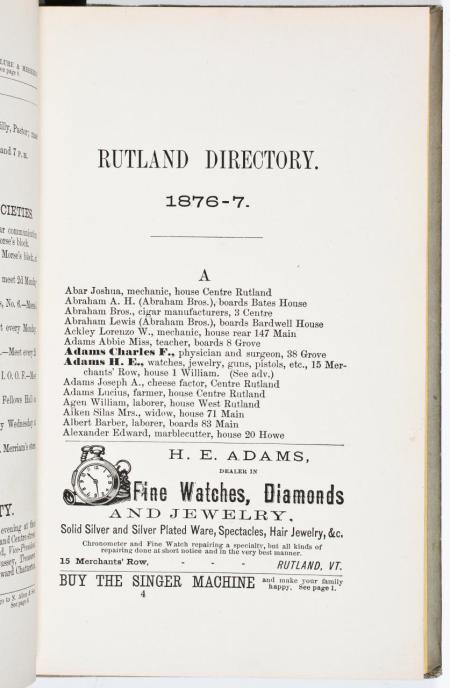
Directories
The American Antiquarian Society has a collection of nearly 7,000
directories published before 1877. It is one of the largest in the United
States, and includes most of the earliest directories printed in
America. The amount of information contained in this collection is
astonishing. It is also very much a reflection of the growth and
development of the country itself.
The first American directory, published in The South Carolina and
Georgia
Almanac for1782, contained a list of 304 names indicating the trades
or professions and addresses of the residents of Charleston, South
Carolina. Three years later, in October 1785, Macpherson's Directory
for
the City and Suburbs of Philadelphia, was the first directory in the
United States to be published separately. This was followed a month later
by Francis White's, The Philadelphia Directory.
Obviously, the essential purpose of a directory is to provide information,
but these early ones -- produced just as the Revolutionary War was ending,
or
shortly thereafter -- also suggest the need to create a sense of order and
solidity in a new society. Although these early directories were modest in
comparison with later publications -- most were the size of a pamphlet or
a
small book -- the titles convey the impression of a comprehensive
vision. The Boston directory of 1789, for example, had the title: The
Boston Directory containing a list of merchants, mechanics, traders, and
others, of the town of Boston, in order to enable strangers to find the
residence of any person. To which is added, publick offices, where, and by
whom kept. Barristers and attorneys at law, and where
residing. Physicians, surgeons, and their places of abode. President,
directors, days and hours of business at the bank. Names and places of
abode of all the engine-men. Illustrated with a plan of the town of
Boston. A map, or plan of the town, so that a "stranger" could find
his
way, was also included in other directories of the time.
Additional information, some of it substantial, began to be included
quite early. James Hardie's, The Philadelphia directory and
register.. .[1794], for example, included an account of the
Pennsylvania Hospital, "the design of which was first suggested by the
late
Dr. Thomas Bond, for the purpose of relieving the sick poor, whether
afflicted in body or mind." Both Hardie's 1794 directory and Cornelius
William Stafford's, The Philadelphia directory, for 1798, tell of
yellow fever epidemics and their effects on the city, the latter account
being shorter than the former by two pages and having the following
explanation: "The Editor intended to have introduced a copious account of
the Yellow Fever, had not Mr. Folwell published one, and secured the Copy
Right, which has deprived him the pleasure of inserting one. Nevertheless,
the editor manages, even in so short a space, to convey the seriousness of
the situation. "In July 1797," he wrote, "the Yellow Fever again made its
appearance in Philadelphia, and providentially for the city, it subsided
so early as the October following. In respect to its origin, the various
opinions which have been advanced, render abortive the intention of giving
any satisfactory account. The melancholy scene which presented itself in
the year 1793, induced many on the confirmation of its being again in
existence, to quit the city."
Within a short time, information became more copious and advertisements
began to appear. In 1802, The Baltimore Directory... printed an
abstract of the revenue laws, listed import duties, places of public
worship and public buildings, and advertised land and water stages,
pleasure gardens, and baths, etc. By 1823, it appears that the titles of
directories were shrinking in inverse proportion to the increase in their
size. The Philadelphia Index, or Directory for 1823: Containing the
names, professions, and residence, of all the heads of families and
persons in business of the city and suburbs, with other helpful
information. By Robert Desilver, contained numerous advertisements, a
perpetual almanac, a list of physicians, directions to the reader, a list
of streets, roads, lanes, alleys, courts, avenues, public places, wards,
wharves and shipyards in the city, government, court and town information,
rates of postage, banks, insurance offices, turnpikes and canals, wardens
of the port, custom house, ministers, consuls, and commissaries of foreign
powers, the census for 1820, etc. In addition, Bailey's Washington
Almanac, for the year of our Lord, 1823 is bound at the back.
The Miners and Business Mens Directory for the year commencing January
1st, 1856. Embracing a general directory of the citizens of Tuolomne, and
portions of Calaveras, Stanislaus and San Joaquin Counties. Together with
the mining laws of each district, a description of the different camps,
and other interesting statistical matter, is of particular interest,
not only for all that the title contains, but also (being a directory of
the gold fields) for a variety of colorful advertisements for such places
as Ferguson's Saloon at Columbia, which had billiard tables, and The Jenny
Lind Restaurant, and W. Sperry, M.D., Shaw's Flat. Keeps constantly in
hand
a general assortment of provisions, mining tools, drugs, and medicines
which he invites the public to call and examine. Other pieces of interest
include A New Theory on the Gold Formation and a poem (extempore), which
begins, In Sonora one hot and sultry day/ Many people had gathered
together/ They were bound to drive the Greasers away/ And they cared not a
fig for the weather/ For folks had been robbed and folks had been
killed...
By the time Volume I of Gould & Aldrichs annual directory of the city
of St. Louis, for 1872 was published, it had 990 pages, with
advertising on every page, and its list of societies included everything
from ordinary temperance societies to "U.A.O. of Druids" and "Red Men" as
follows: "Cherokee Tribe, no. 4 meets every Saturday..., Delaware Tribe,
no. 5, meets every Thursday..., Ontario Tribe, no. 6..., Meramec Tribe,
no. 7."
The collection of Worcester directories extends into the twentieth
century, and some Canadian directories are also included in our
collection. There are also separately shelved collections of trade
yearbooks and railroad directories, each having its own checklist located
in the reading room. The yearbook collection is primarily concerned with
subject rather than
place. Thus it includes such titles as American Racing Calendar and
Trotting Record, from September 1, 1856 to January 1, 1858, and Henry
Chadwick's Baseball Players' Book of Reference containing the Revised
Rules of the Game for 1867.
In 1961, AAS published Dorothea N. Spears Bibliography of American
Directories Through 1860. All new acquisitions are annotated in this
bibliography as they arrive. The directories listed in Spear are available
on microfiche and are shelved in the Society's microform reading room. In
addition, we have recently acquired 453 reels of microfilm for
directories published in the United States through 1880. AAS directories
printed through 1830 are fully cataloged online. A checklist of
directories that have not yet been cataloged is arranged
alphabetically, by the name of the town or city, and is continually
updated.
- Joan M. Pingeton, former Acquisitions Manager;
updated by Jennifer Code, Acquisitions Manager
|
Boston Directory (Boston, 1789)
Boston Directory
Philadelphia Directory
St. Louis Directory
For current information on the cataloging status of this and
other AAS collections, choose "Collection Access" below.
|
|